
An occupational therapist shares the benefits of pet therapy for children on the autism spectrum.
Dogs bring out the best in us. They smile with us when we’re happy, comfort us when we’re sad, and play with us when we need exercise. Their intuition, emotional intelligence, and playfulness make them not only loyal companions but also fantastic fixtures in animal-assisted therapy (AAT).
Also known as pet therapy, AAT has become a popular social science unto itself because of its many benefits in serving members of the autism community. A March 2021 study in the journal Autism found that using therapy dogs has led to a “significant increase in adaptive social and communication skills” amongst children with autism. More than just pets, therapy dogs can help unleash skills in children on the spectrum and provide them with techniques to become stronger communicators.
Benefits of pet therapy
Dating back to at least the 1960s, pet therapy can involve horses, cats, and other animals, though dogs are most commonly employed. Often used in hospital settings to promote healing, these special dogs are also used in schools to assist children with special needs. Therapy dogs offer a bounty of riches, aiding in a child’s physical therapy, occupational therapy, communication skills, emotional wellbeing, and more.
In terms of one’s physical health, dogs make exercise more fun. Unsurprisingly, dogs make for compelling playmates. So, if a child is reluctant to get up and get moving, a dog offers endless possibilities for engagement in physical activities.
Therapy dogs are trained to be well-tempered, well-mannered, and well-socialized, making them perfect for classroom settings. They will run (keeping pace with children) and play soccer (tapping the ball with their nose), encouraging enjoyable movement from the child. Dogs can even sit on a skateboard, inviting children to push and pull them to get some exercise.
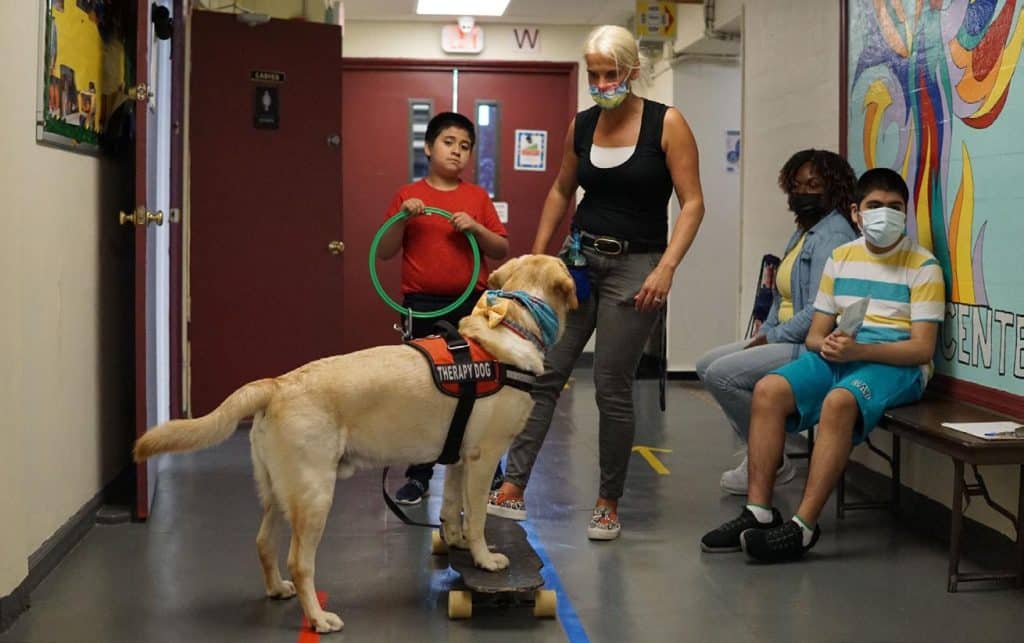
As a complement to physical therapy, dogs can also participate in obstacle courses. Fynn, a yellow English lab who frequents The Phoenix Center in Nutley, New Jersey, crawls through tunnels and walks across balance beams as the charmed students follow along.
Therapy dogs also engage nonverbal children in two important ways. First, the many commands therapy dogs respond to are signaled not just verbally but also via hand motions. This allows children with ASD to practice their nonverbal communication skills. And second, the security and comfort dogs elicit also invites children to communicate (either verbally or nonverbally) with the animal. As children warm up to a dog’s presence, it is not uncommon to see an increase in verbalizations.
In terms of occupational therapy, dogs can help children develop pragmatic skills. In a classroom setting, there might be many children but only one dog—this teaches sharing and turn-taking. This also promotes socialization and communication amongst the children. They also practice eye contact with dogs, feeling more comfortable looking at and addressing them than they might with other humans. This gives children the experience, practice, and skills needed to make eye contact with peers and trusted adults.
Teaching skills using therapy pets
Children can also dress up the dog, making occupational therapy more fun. At The Phoenix Center, students dress Fynn up in clothes, which promotes the practice of various fine and gross-motor skills. In addition, students work on latching a collar and attaching a leash, improving their dexterity. Other activities with Fynn, such as brushing his hair, translate to real-life skills.
Children with autism are often highly tactile as learners, and therapy dogs offer the experience of touch. Students with sensory issues might not invite the touch of another human but will happily nuzzle up with, hug, or pet a therapy dog. Asking a student to groom the dog creates a bond that encourages relationship-building.
And if students don’t wish to engage, communicate, and play, that’s okay, too. The beauty of therapy dogs is that they provide a low-stakes, judgment-free encounter. They ask nothing of their partners, but if they sense discomfort or stress, a therapy dog can be trained to come close to the child, making gentle physical contact to de-escalate the anxious state and encourage self-regulation.
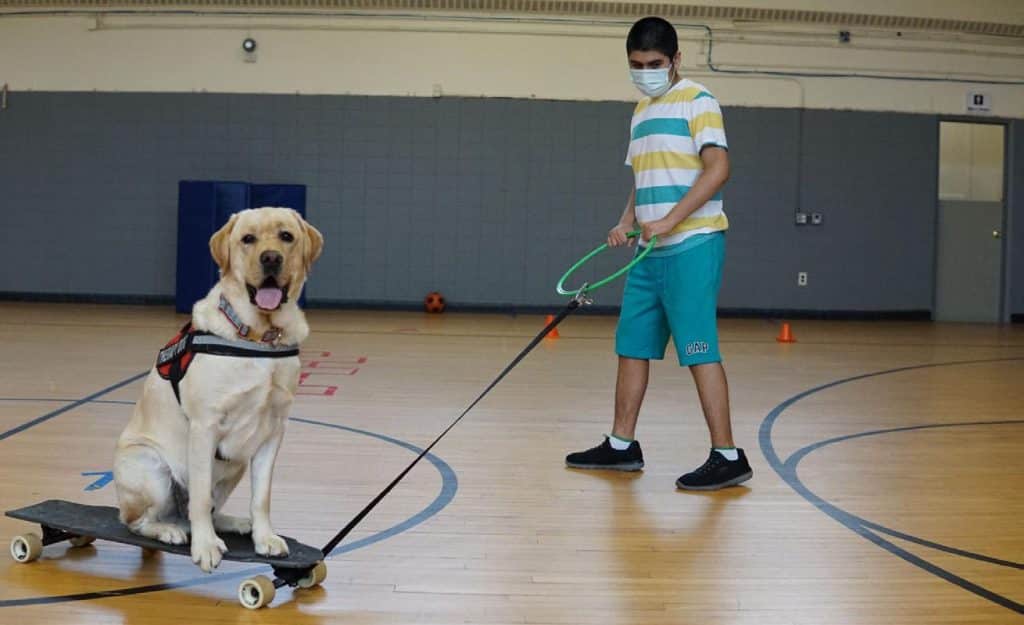
As such, pet therapy programs offer a multitude of ways for children with autism to form bonds and engage in physical and occupational therapy activities that can seem more like fun than work.
Medical News Today noted that pet therapy succeeds in: ”increasing movement and activity through walks and play, providing companionship and decreasing loneliness, while improving mood and general well-being.” Through simple activities like a game of fetch or a grooming session, children can unlock lifelong skills and make a new furry friend along the way.
Trending Products

SENSORY4U Weighted Lap Pad for Kids...

HunnmingRe Weighted Lap Blanket 7lb...

Kivik Weighted Blanket 3lbs, Blue D...

anfie Weighted Blanket Kids (36R...

Kidaddle 5lb Weighted Blanket (Grey...

HOSUKKO Weighted Blanket – 5 ...

yescool Weighted Blanket 5 Pounds C...

5lb Child’s Weighted Blanket ...

MAXTID Weighted Blanket for Kids 5l...