
A mother shares the beauty of her autistic son’s adventurous mind and lessons she’s learned through him.
I live with a real life Sheldon Cooper. My son Lincoln, diagnosed with Asperger’s syndrome, is a 15-year-old genius who ropes off my bathroom with bright yellow homemade signs that say: “Do not enter, experiment in progress!” He is then completely perplexed by my annoyance and calmly explains that I will just have to use the other bathroom for a week or two as mine has the correct ratio of natural to artificial light needed for growing some kind of bacteria that I can’t even pronounce.
I’ve stopped asking where he gets the bacteria samples from. It’s been like this from the moment he started talking. Sitting outside with his grandmother at age five, she exclaimed: “What a beautiful full moon!” He responded by glancing up and stating: “Actually Grandma, that’s a Waxing Gibbous.”
Over the years I’ve learned to live with inconveniences, such as being barred from my own bathroom, along with other whims and routines that may seem nonsensical and random to me, but help him create order from a world that he describes as “completely chaotic”.
For example, he will only eat his favorite food on Saturday, his official “bacon day”. I tried serving it once on Christmas day, thinking that surely such a special occasion would permit a change in protocol. He told me that it would “give him a stomach ache” and refused to eat a single bite.
Lincoln also asks me, every night before he goes to bed: “What’s the plan for tomorrow?” My responses are often single word answers such as “Tuesday.” This is all he needs to know—that he may follow his normal Tuesday routine with no bothersome interruptions or surprises. My son abhors anything that disrupts his schedule just as much as Sheldon Cooper does. When there is an unavoidable change, he often tells me: “I’ll do it, but I don’t like it.”

Understanding atypical personalities
A typical personalities, like my son and The Big Bang Theory’s Sheldon Cooper, are certainly having their moment in pop culture. The phenomenon of “Geek Chic” is growing in popularity, and many of television’s most popular and loveable eccentrics seem to hit somewhere on the autistic spectrum.
I find things in the show funny, because of similar situations happening in my own life, but there is also plenty about the show to give me pause (enough that I don’t let my son watch it with me, for fear that he would feel ridiculed). Author Christine Quail believes that the show’s premise of highlighting “nerds in cultural exile” as comedy may be both problematic and insulting to those who live through the painful feelings that often result from being excluded.
The problem lies in perpetuating a stereotype that falls far short of the myriad personality types of individuals on the spectrum. For example, years ago, my husband was never quite sure which Lincoln would meet him at the door when he arrived home from work. Would it be the child that demanded to be carried back into the house slung over his dad’s shoulders like a sack of ‘taters? Or, would it be the “little professor,” insisting that dad back him up as he lectured his sister about how she could not hold weddings for her stuffed animals, because “animals don’t get married, they just mate in order to perpetuate the species”. Now, in certain situations, Lincoln displays the mindset of a typical 15-year-old boy. But in others, he demands to be deferred to as an intellectual superior (which, to be fair, he often is).
This wide range in the behaviors of autistic children is certainly not portrayed in popular media. It would be impossible for one show to include every single manifestation of autism spectrum disorder (ASD). What would be more plausible is for the media industry to endeavor to show as many different types of ASD characters as possible, instead of only the “stereotypical” one that audiences have come to know.
However, while not all aspects of geekiness should be in vogue, there are a few that perhaps the world would do well to emulate. This idea came to me as I was visiting with a friend who teaches Interpersonal relations at a local community college. My son intrigues her because she observes that while most people care too deeply what others think of them and their conduct, Lincoln doesn’t quite care enough. While most people measure carefully the truths they choose to tell, or to withhold, during a conversation, Lincoln has no filter whatsoever. “This doesn’t interest me mom,” are words I often hear when trying to hold a conversation with him.
People with Asperger’s are often honest to a fault and my sweet son is no exception. More than once I have left a family gathering red in the face because of his blunt honesty. It’s difficult to teach a child that it’s not always necessary to vocalize your honest thoughts. Your favorite aunt may indeed be “fatter than the last time you saw her” but there is no need to tell her so. But while most of us spend our lives wondering what we should do, Lincoln spends his time wondering what he wants to do.
Plans for the future
As a mom who has spent the last 15 years trying to convince her child that it is necessary to think of others’ feelings before you speak, I’m acutely aware that social niceties make the world, well…. nice. But at what point does our need for approval cross over to the dark side? At what point do we stop doing what will make us happy, in order to do what others believe should make us happy.
I’ve told you that my son has an IQ to rival Stephen Hawking (ok, there may be a little bit of parental pride involved in that comparison), but did I tell you what he wants to do with all of those smarts? He insists he will go to school, get a doctorate degree (or two), and then become a park ranger.
His obsession with park rangers started when he was very young, on a family trip to Mesa Verde. We took several ranger-lead tours during our visit, and each time we were lucky enough to be led by the same ranger.
We would be sitting, waiting for the group to start, and I would hear six-year-old Lincoln announce: “There’s Bill!” and then attach himself to the poor ranger’s side. He would ply him with questions and even engage him in several arguments about what Lincoln felt were Bill’s “misunderstanding of the facts.”
It took me a few years to realize it was the lifestyle that appealed to Lincoln so much. He believes that park rangers live much of their life outdoors, in relative solitude, working to keep things in as close to a perfect state as possible. People with Asperger’s often have a slight version of obsessive compulsive disorder (OCD). I haven’t had to tell him to clean his room since he was three years old.
My son has taught me more about living a good, happy life than any other person I know. “Geek” may indeed be “the new Chic” but he couldn’t care less. Judging by his interest in, and contentment with, life, perhaps we shouldn’t care either. What could we accomplish in our own lives if our social inhibitions played no role in informing our decision making processes? How does our fear of social disapproval or rejection limit our willingness to try new things, our discoveries, our triumphs, and ultimately, our happiness?
As my son transitions from child to young man I see in him a fierce determination to follow his own idea of happiness. He has little to no regard for others’ opinions of him or his choices. He has never cared what the world thinks. He will never be repressed by the fear of judgement that holds so many neurotypical people back. Unlike most of us, he has the freedom to make his own decisions and choose his own path based solely on what will make him the happiest. If we could all learn lessons like these from our ASD children, family, or friends, we might be one step closer to living a life of true joyfulness.
Trending Products

SENSORY4U Weighted Lap Pad for Kids...

HunnmingRe Weighted Lap Blanket 7lb...
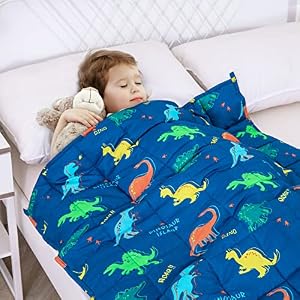
Kivik Weighted Blanket 3lbs, Blue D...

anfie Weighted Blanket Kids (36R...

Kidaddle 5lb Weighted Blanket (Grey...

HOSUKKO Weighted Blanket – 5 ...

yescool Weighted Blanket 5 Pounds C...

5lb Child’s Weighted Blanket ...

MAXTID Weighted Blanket for Kids 5l...