
Why does bullying occur, and what are the policies surrounding this?
Some people with autism may feel anxious or have low self-esteem or self-confidence regarding social engagement. The mental processing needed for social exchange is demanding and may require a moment to withdraw and recharge.
This, unfortunately, can make some the perfect target for bullying.
What parents and children should know?
The limbic system in the brain is where emotions, motivation, and behavior are processed. The amygdalae, two almond-shaped structures known as the emotional center, can be underactivated. This can result in social misinterpretations, which could lead to social bullying.
To safely exit a situation with confidence, an elaborate protective process includes the following systems:
- sensory
- peripheral and central nervous
- limbic
Protecting oneself starts with sensory stimuli that enter the eight pathways:
- sight,
- sound,
- touch,
- smell,
- taste,
- interoception,
- proprioception,
- vestibular.
They travel through the peripheral and central nervous systems, sending a message to the limbic area of the brain.
Each system is purposefully designed to work together. Yet, if incoming sensory information is perceived as overwhelming due to bullying, the process can go off course and lead to exaggerated fears and responses.
When the amygdalae are put on notice, the message can be perceived as a serious situation. The human body responds physiologically through the human organs. This 8th sensory system, interoception, can result in several physical responses such as:
- increased heart rate
- clenched fists or teeth
- swaying
- hair twirling
Interoception allows the child to recognize the warning signs of their organs, enabling them to implement a pre-planned exit strategy away from the threat.
However, without being taught an exit strategy, the child is defenseless. The result can be an inappropriate response, such as fight, flight, or freeze.
Without a plan, the emotional brain takes over, resulting in an inability to protect oneself appropriately. Those who freeze can become targets of further bullying.
Supporting the bullied child
Most individuals with autism are visual thinkers and learners. Using visual supports to preplan an exit strategy empowers them to seek safety.
Teaching an individual to recognize their body’s internal warning system to exit can help minimize or eliminate the risk of bullying. Here are the steps:
Encourage your child
Have them engage in calm dialogue about their fears and bullying concerns. The adult listener always allows the child to process information.
- Use a sensory wheel. Point to interoception. Say and define the word. Encourage your child to repeat it. Ask, “What is your body telling you?”
- Use free, online photos of peers of the same age expressing fear and calm through facial and body movements.
- Compare emotional expressions as your child identifies interoception at work.
- Ask “What does your body do when you feel fear?” Provide supportive statements such as “Do you bite your lip sometimes?” or “Do you get a headache?”
- Print a full-body photo of your child. Have them circle the areas where warning signs occur. Review it with them.
- Empathize with simple phrases, such as “I understand your feelings.”

Brainstorm with your child
Together, determine action options: What can be done rather than what not to do
- Say, “Let’s plan for when you feel fear. What can you do? Could you walk away?”
- Explore the fear of walking away.
- Draw or write emotions shared.
- Ask, “If you walk away, do you know where you would go?”
Most do not know where to go, even if they’ve been told. Brainstorm safe people and places they may go to in the community.
- School: teacher, counselor, or trusted leader
- Grocery store: parent, store manager, or cashier
- Church: parent, clergy, familiar adult, or church office
- Restaurant: wait, staff, or hostess
Draw the actions on paper and list your child’s thoughts for action. Stick figure drawing is fine. Tapping into the visual or right side of the brain helps in remembering what can be done.
Refer to the photo showing internal warning signs to remind them to recognize their body’s signals.
Role-play
This active method supports the memory of skills taught. You can act out real-life situations while recording on your phone. This allows your child to experience the necessary action needed to take refuge safely.
Review the video to support visual learning.
Social Stories™
Write a Social Story™. For example, “When I am afraid, I can…” Write or draw the action steps. Add pictures of your child showing the emotions felt when being bullied. Reference the warning signals photo to act on their exit plan.
Visual cues
Visual cues are excellent, quick reminders of what can be done in any environment. Carry a few key pictures of appropriate can-do skills on a metal ring to flip through and show your child when needed.
Your child can also collaborate with teachers regarding visual cue reminders for bullying safety in school.
One-page profile
The one-page profile is a brief snapshot of your child’s needs or a list of “what can be done” strategies.
Brainstorm with your child. Let them create their profile with their preferred picture. This bonding time assures your child that you are their greatest supporter and allows them to feel empowered with a plan you created together.
This visual can help your child take ownership of their behavior to exit with confidence, while self-advocating and enacting their plan to remain safe.
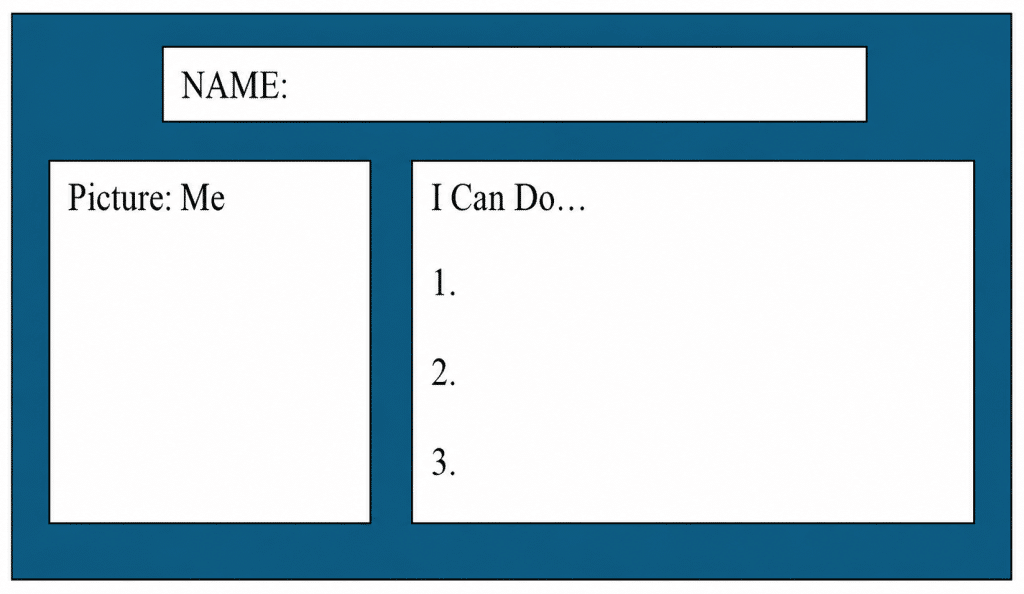
Allow your child to share the one-page profile with teachers who can support your child’s ability to self-advocate.
Responding to school bullying
Bullying is an urgent issue, but addressing it with a plan results in a quicker response. Document concerns, conversations, and phone calls in writing via email.
- Research your state’s bullying policy to reference for staff.
- Remain calm and include facts. For example, on date X, this incident occurred in the gym hallway with X and Y at 1:15.
- Request that all cameras in the areas where bullying occurred be preserved so that footage showing any incidents cannot be recorded over or destroyed.
Under the Family Educational Rights and Privacy Act (FERPA), public school surveillance footage must follow federal regulations. If the footage is related to the student and is kept by the district, it may be treated as an educational record and not always accessible to parents, to protect students’ privacy.
State laws vary for video retention periods. Districts are required to post policies outlining the expected protocol in the District Handbook regarding:
- Footage retention periods
- Secure storage protocols
- Access logs
- Guidelines for footage related to incidents
If you are denied access, request a comprehensive written report via email detailing the video footage.
Meeting with the school
Before the meeting, determine what you know to be appropriate for your child. Then, document everything during the meeting.
Begin negotiations with the school staff in a recorded IEP or 504 meeting, and inform the staff that you will be recording the meeting.
Some possible options to consider asking for during the meeting:
- Counseling support while in school
- A safety plan specific to your child’s needs
- Removal to a new campus: A bullying victim has the right to move to a new campus or request that the bully be removed. The district is obligated to support either option depending on the severity of the case.
- Restorative justice: School officials, including a counselor, meet with your child and the bully to teach and support them to engage in kindness. Ideally, the children learn the necessary skills for life.
- The district pays for private counseling.
If the bullying causes severe trauma and harm, and the above options have been exhausted first, consider seeking a lawyer for advice. This can be costly and emotionally draining. If your child’s case is victorious, the district will pay for your legal fees.
You also have the following options:
- File a State Education Complaint: Be sure to include your state’s code regarding bullying. Public education is required to have a complaint system listed in the District Handbook.
- Contact the Americans with Disabilities Act office for your state.
- File an Office of Civil Rights complaint using the District Handbook’s verbiage.
- Determine an expected outcome; what compensation does your child need?
Moving forward
Bullying is a serious matter; parents’ emotions are real and raw.
To appropriately prepare, review federal, state, and local policies and remain factual to secure the decision makers’ attention and move forward as best you’re able.
Share ideas and progress with your child as much as you believe to be appropriate. Your child will learn from your actions.
Model the behaviors your child has the right to exhibit, supporting them in navigating life interdependently as a self-advocate.
References
Govinfo.gov. (2024) https://www.govinfo.gov/app/details/USCODE-2023-title20/USCODE-2023-title20-chap31-subchapIII-part4-sec1232g
Resources:
https://www.theautismpage.com/one-page-profile/#google_vignette
https://carolgraysocialstories.com/
https://www.niu.edu/citl/resources/guides/instructional-guide/role-playing.shtml
Trending Products

SENSORY4U Weighted Lap Pad for Kids...

HunnmingRe Weighted Lap Blanket 7lb...

Kivik Weighted Blanket 3lbs, Blue D...

anfie Weighted Blanket Kids (36R...

Kidaddle 5lb Weighted Blanket (Grey...

HOSUKKO Weighted Blanket – 5 ...

yescool Weighted Blanket 5 Pounds C...

5lb Child’s Weighted Blanket ...

MAXTID Weighted Blanket for Kids 5l...